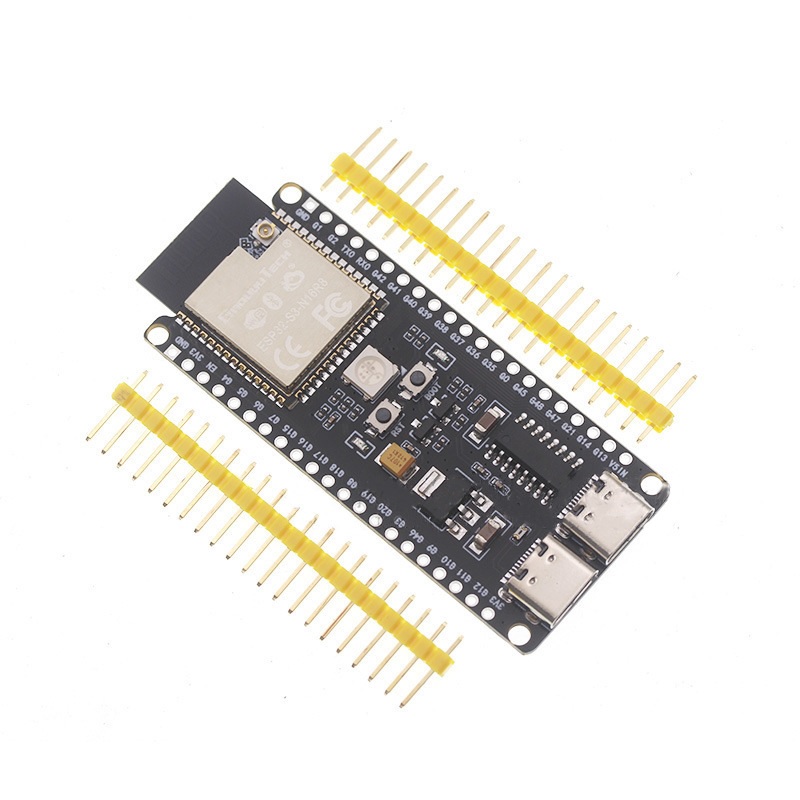
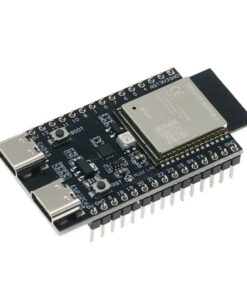
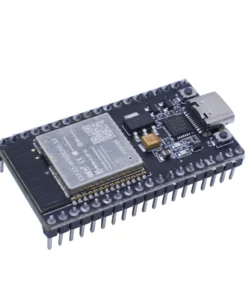
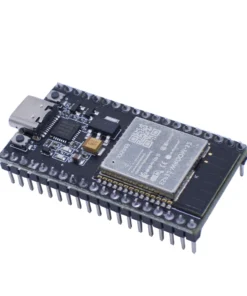
A powerful and versatile ESP32-S3-DevKitC-1 development board featuring advanced WiFi and Bluetooth Low Energy (BLE) connectivity. Built on the ESP32-S3 dual-core processor, this board is designed for high-performance IoT, AI, and embedded applications.
This variant comes with N16R8 configuration (16MB Flash + 8MB PSRAM), providing ample memory for complex applications such as image processing, machine learning, and large firmware projects.
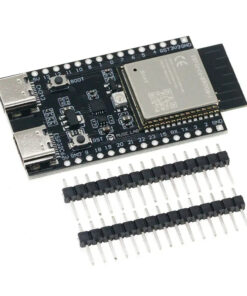
Unwelded (unsoldered) headers give you full flexibility for custom soldering and integration into your own hardware designs.
Key features
- ESP32-S3 dual-core processor for high performance
- WiFi (2.4GHz) + Bluetooth 5 BLE
- 16MB Flash + 8MB PSRAM (N16R8)
- Antenna support (onboard + external option)
- USB interface for programming and power
- Unwelded headers for flexible assembly
- Rich set of GPIO, ADC, SPI, I²C, UART interfaces
What does N16R8 mean?
- N16 – 16MB Flash memory for firmware and storage
- R8 – 8MB PSRAM for high-memory applications
This configuration is ideal for memory-intensive projects such as AI, camera processing, and large IoT systems.
Pinout & connectivity
- USB – Power and programming
- 3.3V / 5V – Power pins
- GND – Ground
- GPIO pins – Digital I/O
- ADC pins – Analog input
- SPI / I²C / UART – Communication interfaces
Specifications
| Microcontroller | ESP32-S3 |
| Processor | Dual-core Xtensa LX7 |
| Wireless | WiFi (2.4GHz) + Bluetooth 5 BLE |
| Flash | 16MB |
| PSRAM | 8MB |
| Operating voltage | 5V (USB) / 3.3V logic |
| Antenna | Onboard + external antenna support |
| Headers | Unwelded (unsoldered) |
Common applications
- Advanced IoT and smart home systems
- AI and edge machine learning projects
- Camera and image processing applications
- Wireless sensor networks
- Robotics and automation
- High-performance embedded systems
Important notes
- Headers are not pre-soldered (requires soldering)
- Operates at 3.3V logic levels
- External antenna may require configuration depending on firmware
Tip: This board is ideal for projects requiring more memory than standard ESP32 boards, especially when working with large datasets or advanced features.
| Weight | 0.03 kg |
|---|---|
| Dimensions | 7 × 3 × 0.8 cm |
Be the first to review “ESP32-S3-DevKitC-1 (N16R8) Development Board – WiFi + BLE | Unwelded Headers, Antenna Support”
Related products
Arduino Compatible
Arduino Compatible
Reviews
There are no reviews yet.